What to Expect From Crushon AI Companions
Most people arrive at AI companions with one question hidden under another: is the conversation any good, and is it comfortable to use. Crushon answers both with a browsable character library and an adult framing that the Crushon home page lays out plainly. This article turns that into a short checklist you can run in one sitting.

Key takeaways
- Judge a session by how it felt, not by how many messages it took.
- Everything you dislike can be changed later, so the first draft matters little.
- Use the platform for a mood, not for facts; it is built for tone, not trivia.
- Give a character four or five turns before deciding it is not working.
What AI companions actually are
The useful way to frame it is to compare it with picking a partner for a mood. Some sessions are light banter, some are a long roleplay arc, and some are a quiet conversation at the end of a day. A good platform exposes all three instead of forcing one style on every visitor.
That range is the point of a character library. Instead of one fixed assistant you see many personas, each with a voice, a backstory and a set of interests, and you keep the handful that read as convincing to you.
An AI companion site is a chat product, not a search engine. You open a profile, send a message and get a reply written to fit the persona you chose. AI companions narrows that idea to adult conversation, where the tone, the scene and the limits are set by you rather than by a script writer.
How people find a companion that fits
When the shortlist is long it helps to see how the platform itself frames adult chat. For a concrete starting point, https://crushon.ai/, which sets out how the characters and categories are organised for adults.
Discovery is the part most guides skip, yet it decides whether the first week feels fun or tiring. Crushon groups its characters so you can start from a mood, a setting or a type of personality, then narrow down rather than scrolling forever.
A workable routine is to shortlist three profiles, chat for five minutes with each and keep the one that needed the fewest corrections. That is faster than reading a hundred descriptions and guessing.
One habit that separates a good session from a bad one is reading the profile before the first message. Tone, interests and stated limits are usually written there, and respecting them makes the replies feel far less generic.
Building a persona instead of picking one
Crushon leans on Creators for its range: many of the AI companions people chat with are built and tuned by other users, so the catalogue grows with the community instead of staying fixed. That is also why two profiles with the same theme can feel completely different.
Creators also give a useful benchmark. If a community-made persona holds a scene together across many turns, that is a fair sign the platform can carry a longer story, not just a quick exchange.
The trade-off is that a very specific brief can box a character in. Leaving one or two details open tends to keep replies lively, while over-specifying every trait can make the persona repeat itself.
What to weigh before a routine forms
Before a platform becomes a habit it is worth putting the choices side by side. The table below is a plain checklist rather than a scoreboard; the right answers depend on how you chat and what you want to keep private.
| Decision | What to check | Why it matters | Quick test |
|---|---|---|---|
| Persona fit | Tone, backdrop and stated limits on the profile | A mismatched persona makes every reply read the same | Read three replies before deciding |
| Time budget | Messages per session and how long a reply takes | The habit only lasts if it fits your day | Time one session, then double it |
| Memory | Whether the chat holds onto earlier turns | Continuity is what makes a longer story work | Mention something from ten turns ago |
| Privacy | Account options and what a profile reveals | Comfort depends on knowing what is shared | Open settings before the first message |
| Cost | What the free tier covers and what unlocks later | Paying only makes sense once the fit is clear | Try it for a week before upgrading |
| Creators | Whether other people build and tune the personas | A lively community keeps the range wide | Compare two profiles with the same theme |
What a good AI reply looks like
Short, specific prompts beat long, vague ones. A sentence naming the setting, the mood and one concrete detail gives the reply something to hold on to, and the difference shows up within one or two turns.
A strong reply keeps the scene going and remembers what you said two turns ago. When a chat feels flat, the cause is usually a vague prompt or a persona that does not match the mood, not a broken model.
Privacy settings worth checking first
Most of the practical detail lives on Crushon itself, and Crushon is a sensible place to start if you want the account, privacy and content options in one view before deciding on a routine.
It is also fine to stop. Closing a chat, deleting a message or switching personas are all normal moves, and treating them as ordinary keeps the whole thing low-stakes.
Comfort is a setting, not a hope. Before you type anything personal, it is worth opening the account options and deciding what you are happy to share and what should stay out of the conversation entirely.
Worked example: sizing the habit
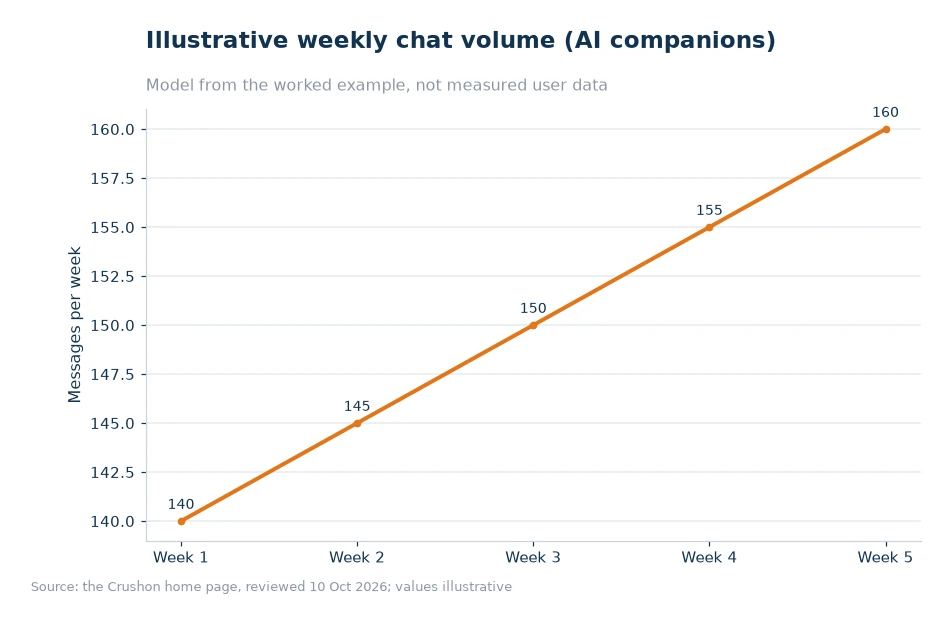
Say you open the app twice a day and send about 10 messages in each session. That is around 20 messages a day, or roughly 600 in a month. If reading a reply and writing the next line takes about 33 seconds, the habit uses close to 330 minutes a month, which is about 5.5 hours. Writing the number down settles the question faster than a feeling does.
Across a year the same pattern reaches about 7,300 messages. A persona that fits from the start removes most of the dead ends, because the time goes into conversation instead of restarts. That is the real argument for spending ten careful minutes on setup.
Frequently asked questions
Why does a chat sometimes feel flat at first?
A thin opening prompt gives the character little to work with, so naming a setting, a mood and one concrete detail usually lifts the reply straight away.
What makes AI companions worth trying for an adult user?
They give an adult a private place to shape a conversation, set the tone and explore a scenario, with no real person on the other side of the screen.
Do I need to pay before I can judge the experience?
A sensible approach is to use the free options first and decide about an upgrade only after the fit and the routine feel clear to you.
A simple next step
Open the page, choose one character that matches your mood, and give it five minutes rather than five hours. That single session tells you more than any comparison table.
Once you know what you want from AI companions, the rest of the settings fall into place quickly, and the experience becomes something you control instead of something you scroll.
Sources: Crushon public pages including the Crushon home page; reviewed 10 Oct 2026. Figures in the worked example and chart are illustrative calculations, not measured results. Intended for adults 18+.[1]