Following a Mining Payout Into the Wallet Balance
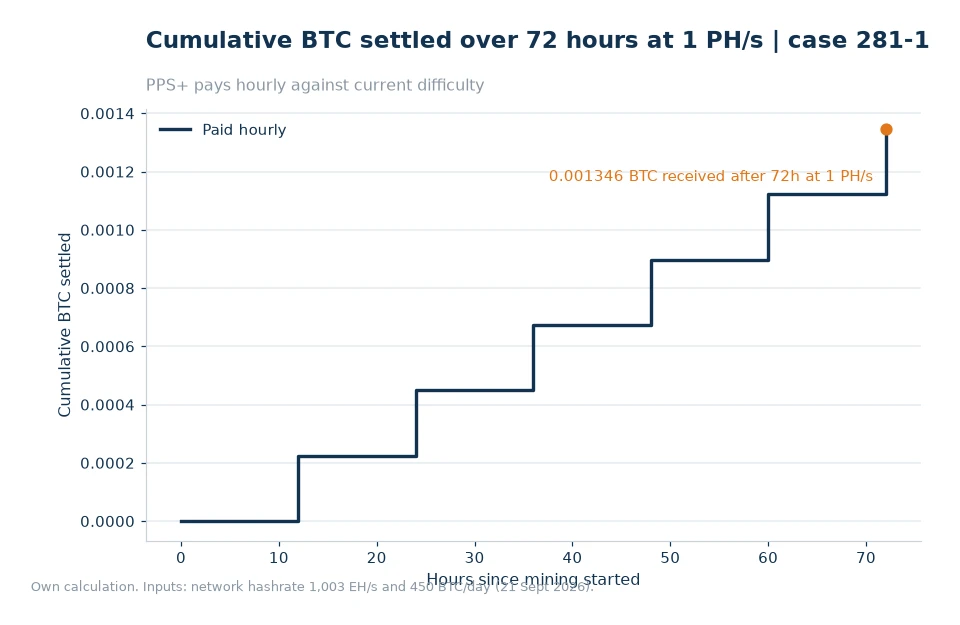
A pool credit only becomes useful money when it lands as a balance you can move. At 1 PH/s, PPS+ settles roughly 0.00001869 BTC an hour, which builds to 0.00044861 BTC in a day and 0.00134582 BTC across 72 hours, about $113.98 at $84,692 per BTC. Tracing that figure from share to spendable coin is the quickest way to prove the whole chain works.

Key takeaways
- PPS+ settles hourly against current difficulty, so a 1 PH/s account gains about 0.00001869 BTC per step.
- Seventy-two hours of uninterrupted hashing adds 0.00134582 BTC, worth $113.98 at the 21 Sept 2026 price.
- An earnings panel and a wallet balance are separate records; only a completed payout moves coin between them.
- Mining withdrawals carry no fee, which makes a small test transfer a cheap way to confirm an address.
The last metre of the payout path
Coins travel through four stages before anyone can spend them. A machine submits shares, the pool converts those shares into a settlement against the current difficulty, the account records a credit, and the wallet holds the resulting balance. Every stage carries its own clock, which is why a new miner refreshing three screens in one afternoon can see three slightly different numbers and conclude, wrongly, that something is broken.
The wallet stage is the one most people skip when they audit a setup. They check that the rig is hashing, check that the worker name matches, and stop. A month later the balance looks thinner than the earnings chart promised. The explanation is usually dull rather than alarming: reported earnings and held coin are not the same measurement until a payout executes and the coin is actually sitting in an address the account controls.
There is a second reason the two figures diverge, and it catches experienced operators as well. A dashboard often displays a projection — what the current hashrate would produce over a day if nothing changed — while a wallet only ever shows what has already been settled. A machine running at 1 PH/s for twenty hours has earned 0.00037384 BTC, but a projection built on a full day will read 0.00044861 BTC. Neither number is wrong. They answer different questions, and mixing them up produces the illusion of a shortfall that never existed.
Reading a balance that arrives in steps
Under PPS+, the block-reward side is priced against current difficulty and paid every hour. At 1 PH/s that step is 0.00001869 BTC, and twenty-four of them make 0.00044861 BTC. The staircase is regular enough that a missing step is visible without any tooling beyond a history list. Because the step is tied to difficulty rather than to blocks found, a quiet stretch on the network does not flatten it.
PPLNS behaves differently, and miners who switch schemes without warning often misread the change. That scheme waits for six confirmations, then splits value by each miner's share of pool hashrate across the last five difficulty rounds. The balance therefore moves in lumps that can be spaced hours apart. A flat afternoon under PPLNS is normal, while a flat afternoon under PPS+ usually means a worker stopped submitting.
For anyone auditing a balance, the practical rule is to compare like with like. Count the hours a worker was actually online, multiply by the hourly figure at your hashrate, and hold the result against the change in the wallet. Do not compare a partial day against a full-day projection, and do not compare a PPLNS lump against an hourly PPS+ step. Both mistakes produce a discrepancy that looks like a missing payout and is really a unit error.
Three checkpoints across three days
The table follows one 1 PH/s account through a long weekend. The middle column stays constant because the example holds difficulty steady; in practice the next estimate of −2.12% would nudge each step slightly upward.
| Elapsed | Credited in window | Running balance | Value at $84,692 |
|---|---|---|---|
| 24 hours | 0.00044861 BTC | 0.00044861 BTC | $37.99 |
| 48 hours | 0.00044861 BTC | 0.00089721 BTC | $75.99 |
| 72 hours | 0.00044861 BTC | 0.00134582 BTC | $113.98 |
The flat middle column is the useful signal. If a row shows less than the one before it, the shortfall is downtime or a worker that dropped, not a fee change. Fees appear in the rate itself, not as a deduction applied later, which is why comparing two balances across the same window is a fair test of uptime.
Worked example
Start with what the network mints and work down to a single wallet balance.
- Network production is 450 BTC a day across 1,003 EH/s.
- Output per TH/s: 450 ÷ 1,003,000,000 = 0.00000044865 BTC daily.
- One petahash is 1,000 TH/s: 1,000 × 0.00000044865 = 0.00044861 BTC a day.
- Hourly step: 0.00044861 ÷ 24 = 0.00001869 BTC.
- Seventy-two steps: 72 × 0.00001869 = 0.00134582 BTC.
- Dollar value: 0.00134582 × 84,692 = $113.98.
- Half the hashrate halves everything: 0.5 PH/s settles 0.00067291 BTC over the same 72 hours, or $56.99.
What the wallet does that the pool page cannot
A dashboard tells you what you produced; a wallet tells you what you hold. The two jobs need different features. Holding means supporting the coins you actually mine, including merged-mining output, without opening a second account elsewhere. The ViaBTC Crypto Wallet sits in the same account as the mining dashboard, so a credit does not have to cross a bridge before it can be withdrawn or converted.
That arrangement removes a class of error that catches people who split operations across services: the wrong address pasted into the wrong field, or a chain selected out of habit. One account also means one history, which matters at tax time and matters more when you are trying to work out whether a quiet week was the pool or your own hardware.
Small balances and the timing of a withdrawal
Zero-fee mining payouts change the usual advice about batching. When the transfer itself costs nothing, the old habit of waiting until a balance is large enough to justify a fee no longer applies, and a miner can move a modest amount to test an address without burning value. Send a small amount first, confirm it arrives, then move the rest. The confirmation wait belongs to the chain, not to the pool.
Two pages are worth reading before the first withdrawal. The listed fee schedule shows which rate applies to which payout component, and the Profit Calculator turns a hashrate into a daily figure you can hold against the balance. Neither replaces the history list, but together they explain why the number on screen is the size it is.
Frequently asked questions
Is a pool credit the same as a wallet balance?
No. A credit is a record inside the mining account, while a wallet balance is coin held at an address. At 1 PH/s the credit grows by about 0.00001869 BTC an hour under PPS+, and it becomes a balance once a payout executes.
How often does the balance change under PPS+?
Hourly, because PPS+ settles against current difficulty every hour. Seventy-two hours of steady hashing at 1 PH/s produces 0.00134582 BTC in seventy-two steps rather than one daily lump.
Does a withdrawal fee reduce the 72-hour total?
Mining payouts carry no fee, so the 0.00134582 BTC figure is not trimmed on the way out. Only the chain's own confirmation time stands between the credit and a spendable balance.
Match the two screens before you move anything
Pick a fixed window, write down the opening balance, and compare it with the credit history for the same hours. At 1 PH/s a clean 24-hour window adds 0.00044861 BTC. If the wallet moved by less, find the missing hours before touching the withdrawal button; a gap that repeats weekly costs more than any single fee discussion. Once the two records agree, the rest of the setup is bookkeeping.
Sources: the wallet, pricing and calculator sections of viabtc.com, where the 4% block-reward rate is published[1]. Readings taken 21 Sept 2026 put the network at 1,003 EH/s with 3.125 BTC per block and BTC near $84,692; figures published 24 Oct 2026 assume continuous uptime and flat difficulty.