RTA Cabinets: What Ships Flat and What You Build
A flat-pack cabinet arrives as a stack of panels, a bag of hardware and a set of instructions, and the gap between that stack and a square carcass is the work you have agreed to do. CasaBuilt publishes four different gauges inside one cabinet: a 1/2-inch plywood box, a 3/4-inch solid birch face frame, 5/8-inch rubberwood drawer sides and a 3/4-inch plywood shelf. Knowing which panel is which is most of the assembly job.
Key takeaways
- Flat-pack cabinets arrive with all hardware and step-by-step guides, plus assembly videos and support.
- The box is 1/2-inch birch plywood; the face frame is 3/4-inch solid birch.
- Drawer sides are 5/8-inch rubberwood with dovetail joints; shelves are 3/4-inch plywood.
- Hinges are soft-close and six-way adjustable; glides are soft-close undermount with full extension.
The carton is a kit, not a cabinet
Open a flat-pack carton and the first surprise is how little it resembles furniture. There is no carcass, no back panel already fixed and no door hanging on a hinge. There are panels, a hardware bag, and a guide. The published description is that the cabinets ship flat with all hardware and step-by-step guides, supported by assembly videos and a support line. That is a complete kit in the sense that nothing else has to be bought, not in the sense that nothing else has to be done.
The trade-off is space and weight. Flat cartons stack against a wall and can be carried by one person, which matters in a walk-up apartment or a house with a narrow hall. An assembled cabinet cannot do either. The same property that makes the kit easy to move is the property that makes it a project.
Before ordering, read the packaging information page and decide where the cartons will live. Parts should be stored until installation, and a stack of panels in a damp garage is a stack of problems.
Panel by panel: the four published gauges
The spec block on the rta cabinets collection page separates four components by thickness, and the differences are deliberate. The box side is thin because plywood carries load across its face. The face frame is thick because it is the edge the doors close against. The drawer side sits between the two. The shelf matches the face frame because it spans the widest unsupported distance.
| Component | Material | Published thickness | Job in the build |
|---|---|---|---|
| Box side | Birch plywood | 1/2 inch | Forms the carcass and carries the load |
| Face frame | Solid birch, 1-1/2 inches wide | 3/4 inch | Takes hinges and closes the front edge |
| Drawer side | Rubberwood, dovetail | 5/8 inch | Holds the drawer box square |
| Shelf | Plywood, adjustable | 3/4 inch | Spans the cabinet without bowing |
The door is a separate assembly: a rubberwood frame around an MDF panel in a full-overlay Slim Shaker profile. That frame is why the door feels stiff in the hand while the panel keeps it light. The finish is seven coats of paint with a UV protective layer, applied before the kit is packed, so no finishing is part of the assembly job.
What assembly actually involves
The work is joining panels square, fitting the hardware and hanging the door. Square matters more than tight. A carcass fastened with the diagonals out by a quarter inch will fight the drawer glides for the life of the cabinet, and no amount of hinge adjustment will close a door on a twisted box. Assemble on a flat floor, check both diagonals before the final fasteners go in, and keep the box on its back while the glue or fasteners set.
Doors and drawers go on last. Hanging a door on an unboxed cabinet is how panels get scratched. The published hinges are concealed, soft-close and six-way adjustable, which means the door can be shifted up, down, left, right and in or out after it is on. That adjustment range exists because site conditions are never perfect; use it rather than shimming the carcass.
Wall cabinets are a two-person job regardless of who assembled them. The cabinet has to be held on a level line while the screws go into studs, and a 30-inch wall cabinet is awkward before it is loaded with shelves.
Work in batches rather than cabinet by cabinet. Sorting panels by size first, then building every base, then every wall, keeps the hardware bag organized and makes the second cabinet noticeably faster than the first. Lay the parts out in the order the instructions call for them before any fastener goes in; most flat-pack mistakes are panels installed backwards on step two and discovered on step seven.
What not to substitute during the build
The hardware bag is not the place to improvise. Soft-close undermount glides with full extension are matched to the drawer box depth, and a shorter glide from a hardware store will change how far the drawer opens and how it sits in the opening. The same applies to the hinges: a six-way adjustable hinge is doing alignment work that a fixed hinge cannot do.
The published warranty is one year against manufacturing defects in materials and workmanship under normal residential use, with a replacement part or an agreed solution as the remedy. It does not cover a panel cut wrong on site or a hinge screwed into the wrong place. Keep the hardware bag and the instructions until the kitchen is finished, because the part numbers on the bag are how a replacement gets ordered.
One substitution is safe: a better drill bit. The rest of the kit is a system, and mixing parts inside a system is how a cabinet ends up with a drawer that closes on one side only.
Worked example: reading the gauges as fractions
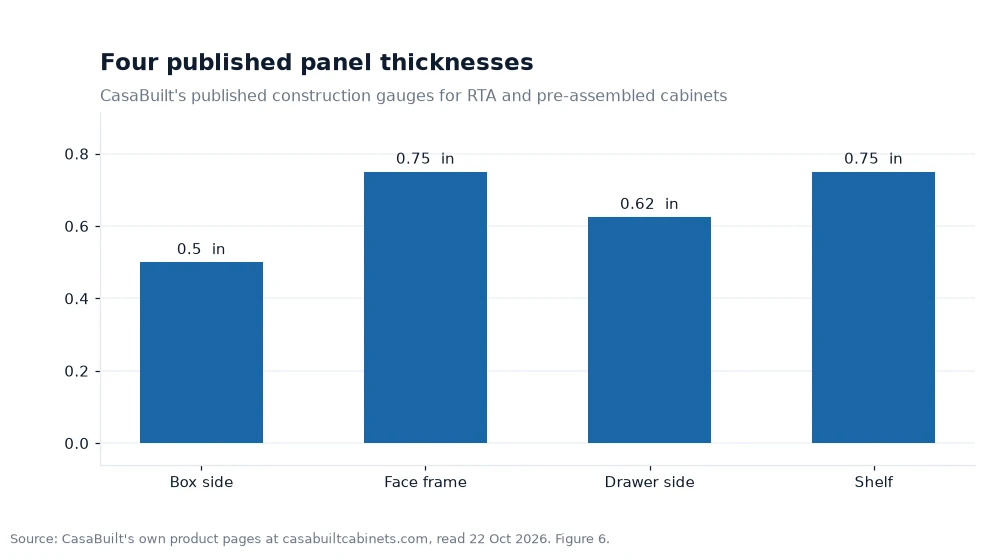
The chart gives four values in inches: box side 0.5, face frame 0.75, drawer side 0.625 and shelf 0.75. Convert each to eighths. Half an inch is 4/8, five eighths is 5/8, and three quarters is 6/8. The face frame is therefore 6/8 against the box's 4/8, which is 1.5 times the thickness. The shelf matches the face frame at 6/8, and the drawer side sits one eighth below both at 5/8.
Add the four gauges: 0.5 plus 0.75 plus 0.625 plus 0.75 equals 2.625 inches, or 21/8. Divide that sum by the 0.5-inch box side and the answer is 5.25, so the four published gauges together stack to five and a quarter times the thinnest panel.
In metric, one inch is 25.4 millimeters. The box side is 12.7 mm, the face frame and shelf are 19.05 mm, and the drawer side is 15.875 mm. Those conversions are worth doing once if the hardware you are checking is specified in millimeters, which most European hinge patterns are.
Frequently asked questions
What tools do I need to assemble a flat-pack cabinet?
A drill, a screwdriver, a tape measure, a square and a level cover the carcass. A rubber mallet helps seat panels without marking them, and clamps hold a joint while fasteners go in. The kit includes the hardware and guides; tools are not part of the carton, and the published assembly videos show the sequence before you start.
Do the drawers arrive assembled?
The published specification describes 5/8-inch rubberwood drawer sides with dovetail joints, and the cabinet ships flat with hardware and guides. Treat the drawer as part of the build until the instructions say otherwise. Dovetail joints are a construction detail, not a promise that the drawer box is pre-built.
Can I assemble the cabinets before the room is ready?
You can, but you need somewhere flat and dry to store them. Assembled carcasses take floor space and are harder to move through a finished hallway than flat cartons. Many buyers assemble in the room being renovated, keep the doors off until the boxes are fixed to the wall, and store panels flat rather than leaning.
Open one carton before you order twelve
Order a single cabinet first, or the smallest base in the line, and build it. The exercise answers the questions a product page cannot: whether the instructions match your reading, whether the hardware bag is complete, and whether you want to do this eleven more times. It also produces a square carcass you can measure before the rest of the order ships.
Flat-pack is a good deal for a buyer with a flat floor, a free weekend and a second pair of hands. It is a bad deal for a buyer who needs a finished room on Friday. The panels are the same either way; the difference is who does the joining.
Figures quoted here come from the manufacturer's own website, read 22 Oct 2026[1].