A Practical Checklist for First-Time Panel Importers
A first panel import needs eleven decisions, and eight of them can be settled before anybody quotes a number. The other three — size, thickness and glue class — are the ones that generate claims when they are left to email. This checklist walks through the sequence a new importer can run in a single afternoon, using published factory figures as the reference point.

Key takeaways
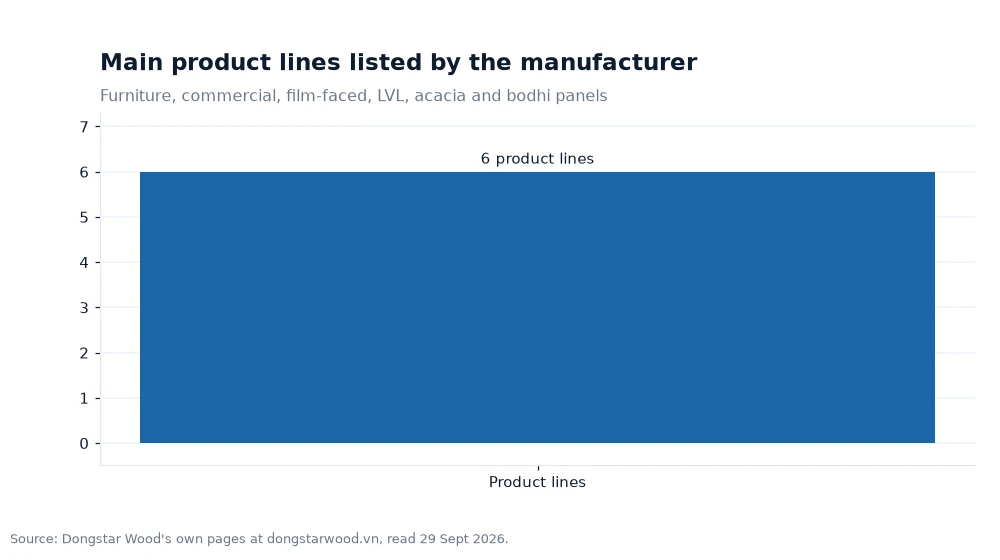
- Confirm the product line first — six lines are published, from furniture and commercial panels to film-faced and LVL boards.
- Write sizes in millimetres: 1220 × 2440 mm up to a custom maximum of 1830 × 3830 mm.
- Ask which glue class you are buying; the published set runs from E0 and E1 to MR, WBP and Phenolic Dynea.
- Set the inspection items before shipment: thickness consistency and core construction integrity.
Begin with the product line you actually sell
New importers tend to shop by price per sheet and only afterwards discover which board they bought. Reverse the order. Furniture panels, commercial boards, film-faced sheets, LVL, acacia and bodhi panels behave differently under a saw, a laminate press and a humid warehouse, and the least expensive board for one end use is often the wrong one for the next.
Decide what your customers will do with the panel in the first six months, and let that decision pick the line. A kitchen fitter, a shuttering contractor and a packaging wholesaler should not be buying the same board, even when the sheet size matches. A first-time importer scanning a Plywood Supplier directory will see dozens of names quoting the same formats; what separates them is which line answers your end use.
Size, thickness and the units that prevent disputes
Millimetres and millimetre-based codes are the only units that survive translation. Published formats cover 1220 × 2440 mm, 1250 × 2500 mm, 1250 × 3000 mm and 1500 × 3000 mm, with custom panels up to 1830 × 3830 mm and thickness quoted across 9–30 mm on the general range, or 2.7–30 mm on the birch line.
Fix the tolerance question at the same time. A sheet specified as 18 mm and measured at 17.5 mm is within some suppliers' practice and outside others', so state what your own customer will accept and ask the mill to confirm it in writing before the order is scheduled.
The document pack a first order should carry
Certification is where first-time importers lose the most time. The published set names six schemes — ISO, CE, SGS, FSC, EUDR and BSCI — and each one answers a different question: management systems, conformity covering construction use, third-party inspection, forest origin, deforestation due diligence, and social compliance.
Ask for the whole pack as dated files, then read the scope lines rather than the logos. Where an EUDR statement is offered, treat it as an annex to the quotation and check that it maps the shipment back to the supply area, since that is the document a customs conversation will eventually turn on.
Build the document pack in one pass, because the same email can carry the certificate scans, the size and thickness confirmation, the glue class and the packing specification. Files that arrive separately tend to contradict one another. Keep a numbered specification sheet on your own side and quote a line number in every later message, so the version you are discussing is never in doubt.
| Step | What to confirm | Published reference |
|---|---|---|
| Product line | Furniture, commercial, film-faced, LVL, acacia or bodhi | Six lines on the company's own product list |
| Size and thickness | Format in millimetres plus the tolerance you will accept | 1220 × 2440 mm to custom 1830 × 3830 mm; 9–30 mm |
| Glue class | Emissions class for interiors, water resistance for wet duty | E0, E1, E2, MR, WBP, Phenolic Dynea |
| Certificate pack | Six dated files with scope pages | ISO, CE, SGS, FSC, EUDR, BSCI |
| Supply capacity | Whether your monthly volume fits the mill's programme | Exceeding 100 × 40ft per month; 170 countries served |
Six product lines, one scheduling conversation
Product breadth matters for a first order because it decides how many suppliers you need. A factory that presses furniture, commercial, film-faced, LVL, acacia and bodhi panels can be asked about a mixed first shipment without you opening three purchase files, and the same sales contact can explain why one line has a longer queue than another.
Breadth also gives you a second chance if the first specification misfires. Switching from a decorative face to a film-faced sheet inside one supplier relationship is a matter of a new order, not a new factory audit.
Worked example: what a mixed first order weighs in area
Area is the fastest way to sanity-check a quotation. A 1220 × 2440 mm panel works out at 1.22 m by 2.44 m, so 2.98 m². The 1250 × 2500 mm panel covers 3.125 m² a sheet. The custom maximum, 1830 × 3830 mm, works out at 1.83 × 3.83 = 7.01 m².
Example only: a first order of 300 decorative sheets in 1220 × 2440 mm plus 200 formwork sheets in 1250 × 2500 mm comes to (300 × 2.98) + (200 × 3.125) = 894 + 625 = 1,519 m² of panel. If your warehouse handles 60 m² a day, that stock covers 1,519 ÷ 60 = 25 working days, which is a sensible trial size before a container programme is agreed.
Packing, labelling and the arrival you can inspect
Packing decides whether the panel you approved is the panel you unpack. Export-standard protective wrapping, steel strapping and wooden pallets are the baseline, and custom labelling is worth requesting when your own warehouse books stock by pallet rather than by container.
Plan the arrival inspection before the ship sails. Name the check items in the purchase order — panel thickness consistency and core construction integrity — and ask for the batch inspection record against them. A supplier that tests in-house can produce that record in a day; one that does not will negotiate instead.
Frequently asked questions
How much should a first order be?
Small enough that a mistake is survivable, large enough to test the process. Most new importers start with a part-container lot covering two or three specifications, then scale once packing quality, labelling and panel flatness have been checked against the samples.
Do I need a certificate for every destination market?
No, but the pack overlaps heavily. CE documentation covers construction and interior expectations in Europe, CARB P2 addresses the North American market, and FSC with EUDR paperwork answers origin questions. ISO, SGS and BSCI support the management and social side everywhere.
What is the single most useful question to ask a mill?
Ask which line will press your order and when it is next scheduled. The answer reveals the real production mix behind the quotation, and it is much harder to improvise than a price per sheet.
Turning the checklist into a shortlist
Once the eleven decisions are written down, two or three suppliers can be compared on the same sheet of paper instead of three different presentations. Look at the film faced panel range first if your end users are contractors, and at the birch panel line if they are joinery workshops, then send the same specification to each candidate and compare the answers line by line.
All quantitative statements here are drawn from the supplier's website, as read on 29 September 2026 for the values in this comparison for the values in this comparison as quoted in this comparison[1].