Microbrewery Systems From 1,000 to 3,000 Litres
The 1,000 to 3,000 litre band is where most first commercial breweries land: big enough to supply a taproom and a few accounts, small enough to fit a leased unit and a single operator's day. HGMC builds that class as a defined micro craft range, and the published ceiling for microbrewery equipment is 18,000 barrels or less a year — far above what a single brewhouse at this size will usually produce. The decisions that matter are vessel count, heating method and control level.
Key takeaways
- The published micro craft range runs from 1,000 to 3,000 litres, with nano systems at 5 BBL or less and large commercial equipment above that.
- A 1,000 litre system brewed twelve times a month is 144,000 litres a year, or about 1,231 barrels at 117 litres to the barrel.
- Vessel configurations run from 2 to 5 vessels, with steam, direct fire or electric heating and PID, semi-automatic PLC or fully automatic PLC control.
- The manufacturer publishes 90–150 days from deposit to door delivery and a 6-year warranty on tank accessories and electronic components used within scope.
What the 1,000 to 3,000 litre class covers
At this size a complete brewery is still a compact object: brewhouse vessels on a platform, fermentation tanks in a row, a glycol tank and chiller against a wall, a control cabinet and a small CIP station. That is why the class fits restaurants, commercial and industrial buildings and converted units rather than purpose-built plants. Below it sits the nano band at 5 BBL or less, which takes very little space and is often used to prove a beer before investing further; above it, the equipment ladder runs from 100 litres at the bottom to 200 tonnes at the top for buyers planning at industrial scale.
The practical question is not which tank size is available but which batch volume keeps your brew day sensible. A 1,000 litre brewhouse on a two-vessel configuration is a comfortable one-person operation; a 3,000 litre set with four vessels and steam heating is a small production plant that will want two people on brew day and a proper cleaning schedule.
Who a micro system suits
The clearest fit is a taproom or brewpub that sells most of its beer across the bar. There, the brewhouse is part of the experience, the tanks are visible, and 1,000 to 2,000 litres a batch covers a week or two of draught demand. The second fit is a small producer selling into a handful of local accounts, where consistency between batches matters more than peak volume.
What this class does not suit is a brewery whose business plan depends on national distribution from year one. If the plan calls for packaged beer in volume, the honest comparison is against the large commercial systems, where equipment reaches up to 100 hectolitres and the hot products are the 20 to 50 tonne and 5 to 20 BBL systems. Choosing the smaller class and growing into it in stages is a legitimate strategy as long as the site has room for the next step, and buyers who are weighing a taproom-sized craft beer equipment set against a larger one should start from the sales forecast rather than from the tank price.
Vessels, heating and control at this size
HGMC offers brewhouses in 2, 3, 4 and 5-vessel configurations, with steam, direct-fire or electric heating and a design that supports either decoction or infusion brewing. Fermentation tanks and bright tanks are supplied alongside, which matters because the cold side is usually what limits output at this size rather than the kettle. Where the brewing method is settled early, the vessel set can be matched to it instead of being adapted afterwards.
Control is the other decision, and it changes the working day more than the tank wall thickness does. The published options are a PID display control panel, a PLC semi-automatic touch screen, and a PLC fully automatic control panel with curve indication and production-record printing. For a brewery that intends to repeat recipes exactly, the automatic level pays for itself in records alone; for a taproom brewing a handful of core beers, the middle option is usually the sensible compromise.
Fabrication detail is worth checking at any size: TIG 100 percent full welding joints, polishing accuracy of 0.4 micrometres or finer, and stainless steel 304 or 316 in 3 mm and 2 mm plate. Vessels use SUS304 food-grade material certified by SGS, and the quality system is in compliance with ISO9001:2015.
| Class | Batch volume | Where it fits |
|---|---|---|
| Nano | 5 BBL or less, about 585 litres | Restaurant or taproom pilot with minimal floor space |
| Micro craft, entry | 1,000 litres, about 8.5 BBL | First commercial brewery selling across one bar |
| Micro craft, mid | 2,000 litres, about 17 BBL | Brewpub adding a small wholesale round |
| Micro craft, top | 3,000 litres, about 26 BBL | Regional start with steam heating and more vessels |
Worked example: how much room the ceiling leaves
Example, with assumptions stated. The published microbrewery ceiling is 18,000 barrels a year. At 1 BBL to 117 litres that is 18,000 × 117 = 2,106,000 litres a year. On a 3,000 litre batch that ceiling would need 2,106,000 ÷ 3,000 = 702 brews a year, or 702 ÷ 12 = 58.5 brews a month — roughly two a day, every day. The ceiling is therefore not the constraint; tank space, cold storage and sales are.
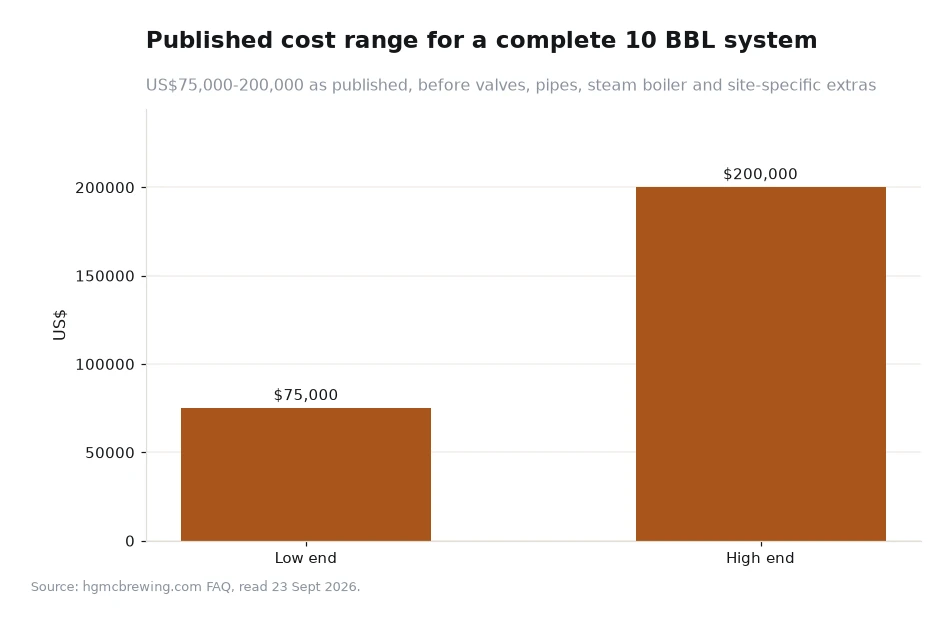
Look at the same arithmetic from the other end. Twelve brews a month on 3,000 litres is 12 × 3,000 × 12 = 432,000 litres a year, about 3,692 barrels. On a 1,000 litre kit the same rhythm gives 144,000 litres, or roughly 1,231 barrels. Now place the published price range next to that: a complete 10 BBL system, about 1,170 litres, is published at US$75,000–200,000, which is 75,000 ÷ 1,170 ≈ US$64 per litre of batch capacity at the low end and 200,000 ÷ 1,170 ≈ US$171 at the high end. Valves, pipes, a steam boiler and site-specific extras sit outside that range, so treat the figures as an order of magnitude rather than a quotation.
Frequently asked questions
What batch size counts as a microbrewery system?
The published micro craft range runs from 1,000 to 3,000 litres, with nano equipment at 5 BBL or less and large commercial systems above the micro class. A microbrewery is described on the manufacturer's pages as producing 18,000 barrels or less a year.
Can a 1,000 litre brewery be run by one person?
On a two-vessel configuration, yes: a 1,000 litre brew day is a manageable single-operator routine. Larger sets with three or more vessels and steam heating generally want two people on brew day plus a planned cleaning rota.
Getting a layout for your size class
The manufacturer offers 2D, 2.5D and 3D design work free of charge, covering brewery space layout plus vessel and piping design, which is the least costly way to test whether a 1,000, 2,000 or 3,000 litre set fits the room you have. Sales are reachable 24 hours a day, and installations are published by country and size — Poland, France, England, Korea, Hungary, Canada, Italy, Spain, Australia, Denmark, the Netherlands, Costa Rica, Germany, Estonia and the United States all appear on the case list.
Start from the HGMC home page, then look at how the complete breweries are grouped on the brewery-system pages and at the wider beer brewing equipment list. Send your batch volume, beer styles and room measurements, and ask for a 3D layout at the size you are actually considering rather than the size you hope to sell.
Figures in this article come from the manufacturer's own website, read 23 Sept 2026: the 1,000 to 3,000 litre micro craft range, the 18,000 barrel ceiling, the 5 BBL nano class, the 2 to 5-vessel configurations, the heating and control options, the fabrication details, the published price range of US$75,000–200,000 for a complete 10 BBL system, the 90–150 day delivery window, and the 6-year warranty on tank accessories and electronic components against manufacturing defects from the factory, used within scope. Barrel conversions and cost per litre are this article's own labelled examples.[1]