A small first order is not a scaled-down version of a large one; it is a different project, and it fails for different reasons. The four things worth settling before any price is agreed are the written brief, the retained sample reference, the minimum order quantity, and the document pack the factory will issue. A supplier who is willing to work through those four items before quoting is usually the same supplier who can actually run the order.
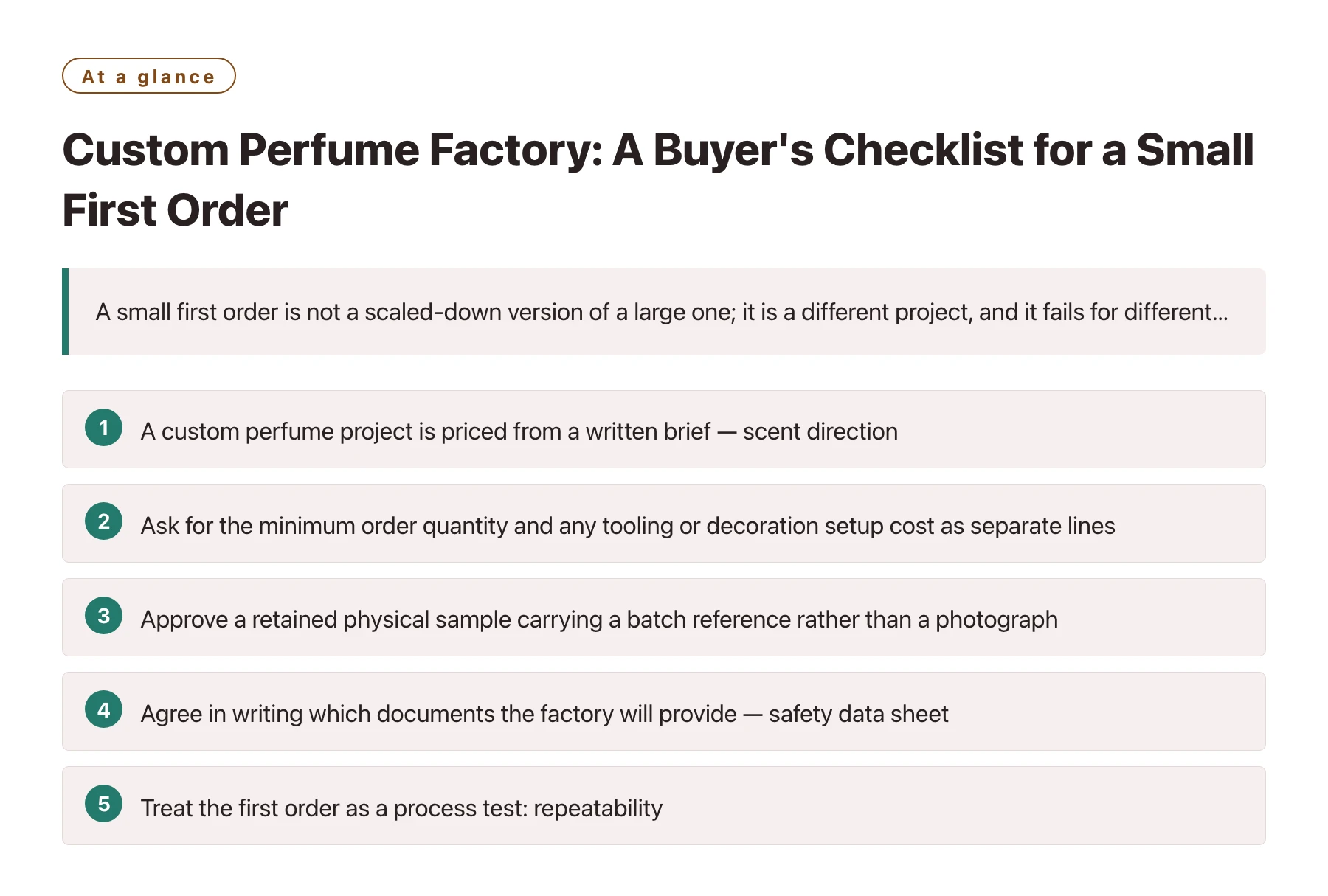
Key takeawaysA custom perfume project is priced from a written brief — scent direction, price target, pack format and destination market — not from a verbal idea, so the brief is the first deliverable. · Ask for the minimum order quantity and any tooling or decoration setup cost as separate lines, because that is the only way to see which part of the quote is fixed and which part scales with volume. · Approve a retained physical sample carrying a batch reference rather than a photograph; this single habit removes most disputes that surface at the bulk stage. · Agree in writing which documents the factory will provide — safety data sheet, IFRA conformity statement, allergen declaration — and at which stage of the project each one is issued [1]. · Treat the first order as a process test: repeatability, lead time and paperwork matter more than the unit price, because they decide whether the second order is uneventful.
Most first-time buyers open the conversation by asking what a bottle costs. It is an understandable question and a poor one, because the answer depends on decisions nobody has made yet: how much development the factory is expected to do, what the bottle is made of, how it is decorated, and what the destination market will ask for at import.
The checklist below is written for the case where the order is small — a pilot run, a single launch SKU, or a first production batch for a young brand. Small orders are where the assumptions are least tested and where the cost of a misunderstanding is highest relative to the value of the order.
None of this requires a large budget. It requires that four or five things be written down instead of assumed.
Write the brief before you ask for a price
A factory cannot price an idea. It prices a specification: a scent direction with references, a target cost per unit, a pack format with a material and a fill size, an expected quantity for the first run and an indication of the annual volume if the product works, and the country where the finished goods will be sold.
The destination market is not a formality. It determines which allergen information has to appear, which restricted materials have to be avoided or limited, and which documents the importer will ask for. A brief that omits the market will produce a quote that later has to be revised, and revised quotes are where schedules slip.
Buyers who want development support rather than pure production should say so explicitly. A factory organised around custom fragrance R&D and production will quote the development step, the sample rounds and the production run as distinct items, which makes the total comparable with another supplier's total.
What the brief has to contain
Five lines are enough to start: the scent family and two or three reference products, the price band you need to land in at retail, the pack format including material and fill weight, the first-order quantity and the annual estimate, and the sales market. Add a sixth line for anything non-negotiable — a claim you intend to make, a material you will not use, or a certification your retailer requires.
Why the price target belongs in the brief
Giving the factory a target retail price and a required margin is not the same as asking for a discount. It tells the formulator how much of the cost budget can go into the concentrate and how much has to come out of the pack. Without that information, the first sample is often technically lovely and commercially unusable.
The five gates of a small custom run
- Brief and feasibilityThe factory confirms it can work in your category and market before any development time is spent; this is also when the minimum order quantity should be stated in writing.
- Development and first sampleModifications are normal at this stage, so agree how many revision rounds are included and what an extra round costs.
- Sample approvalApproval creates the reference for everything that follows. The the stages of perfume production, from compounding through filling, are judged against this one retained sample.
- Pack and decoration sign-offArtwork, glass or plastic decoration, labelling and carton are approved separately from the juice, usually with a pre-production sample.
- Production and releaseThe run is executed against the approved reference, then released with the document pack and a retained sample from the actual production batch.
What to ask, and what a good answer sounds like
| Question | Answer that should worry you | Answer worth accepting |
|---|---|---|
| What is the minimum order quantity? | A number given verbally and revised after the sample is approved | A number in the quotation, with the reason it sits where it does |
| What does development include? | An open-ended promise to 'get it right' | A stated number of sample rounds and the cost of additional ones |
| Who owns the formula? | Silence, or 'we will keep it safe for you' | A written position on formula and mould ownership before you pay |
| Which documents come with the goods? | 'Everything you need' | A named list, with the stage at which each document is issued |
| What happens if the bulk does not match the sample? | 'That never happens' | A defined comparison against the retained reference and a remedy |
Two of these answers are commercial terms rather than technical ones, which is why they belong in the same conversation as the price. Buyers who only interrogate the technical side often sign a quotation that says nothing about ownership or remedy.
Where a small custom order actually goes wrong
The failures are rarely dramatic. More often the bulk order arrives looking slightly different from the approved sample, and nobody can prove it, because there is no retained reference with a batch number. Or the label artwork is approved as a PDF, the printer interprets a colour differently, and the run is technically correct and commercially unusable. The remedy is unglamorous: work with a custom perfume factory that will confirm the scope line by line, and then hold both sides to that list.
A second common failure is an unstated assumption about decoration. Buyers frequently assume that a bottle price includes printing, coating or a pump, and factories frequently quote the bare container. Both parties are behaving reasonably, which is exactly why the scope has to be listed line by line. Using a plant that describes itself as offering fine fragrance manufacturing does not remove the need for that list; it just makes the list easier to obtain.
A third is the mismatch between a small first order and a factory built for volume. This is not a defect in the factory. It means the buyer should ask earlier whether the line can be scheduled economically at the requested quantity, and whether the minimum is a hard floor or a soft one that changes with the pack.
Keep one reference sample under lock
The retained sample is the cheapest form of insurance in the whole project. It should come from the approved batch, be sealed, be labelled with the date and the batch code, and exist in two places: at the factory and at the brand. Every later comparison — bulk release, repeat order, complaint — is made against it. Where a market requires independent results rather than the manufacturer's own, third-party laboratories provide that batch-level testing for cosmetics and personal care [2].
If you only do one thing differently on your first order, do this: put the brief, the minimum quantity, the ownership position and the document list on a single page, and have both sides confirm it before the sample work starts. Nothing on that page needs a lawyer. It simply removes the four assumptions that small orders are most likely to be built on.
Choosing between two factories that both look competent
When two quotations come back at a similar price, the difference is usually in how each supplier answers questions rather than in what they charge. A supplier that responds to the brief with clarifying questions is doing development work before being paid for it, which is a reasonable signal. A supplier that returns a price within a day, with no questions, has either misunderstood the brief or is quoting a catalogue item.
It also helps to ask what happens after launch. A fragrance that sells will need a repeat order, possibly a second size, and eventually a line extension. Asking now how the factory handles a repeat run — whether the concentrate is held, how long it is kept, and what notice the schedule needs — costs nothing and tells you whether the relationship has a second chapter in it.
Sources
- IFRA Standards Library (International Fragrance Association) —— The IFRA Standards Library lists the restrictions the fragrance industry applies to individual fragrance ingredients, based on safety assessments; it is the reference point for compliant fragrance formulation.
- SGS: Cosmetics, Personal Care & Household Testing —— Testing, inspection and certification services for cosmetics and personal care, including microbiological, stability and safety testing aligned with cosmetics GMP.
Frequently asked questions
What is a realistic minimum order for a first custom perfume run?
It varies with the pack and the factory, which is why the number should come from the supplier rather than from a general rule. What matters for planning is that the minimum, the tooling or decoration setup cost and the development fee are quoted as separate lines, so you can see what you are paying for at a small volume.
Do I need my own formula to approach a custom perfume factory?
No. Plenty of projects start from a brief and a set of references, with the factory developing the scent. The practical difference is commercial: if the factory develops the formula, ask early whether the result will be exclusive to you and who owns it, because that answer affects what you can do with the product later.
How many sample rounds should I expect?
Two or three rounds is a common allowance for a straightforward brief. Complex briefs, unusual pack formats or a very specific reference may need more. The number itself matters less than knowing it in advance, because the cost of an extra round is usually charged.
Which documents should arrive with the first order?
At minimum a safety data sheet, a statement of conformity with the relevant fragrance standards, and allergen information for the finished formula. The exact list depends on the destination market, so ask the factory to name the documents it issues and confirm which ones apply to your country.
Is it worth paying more per unit for a smaller first order?
Usually yes, because the point of the first order is information rather than profit: does the supplier repeat the approved sample, hit the quoted lead time, and deliver usable paperwork. Those answers are worth more than the difference in unit cost, and they are much cheaper to obtain on a small run.